


Reference Formel D: STRADIVARI
Digital Material Flow for Time-Critical
Supply to Production Lines
Our Client
Formel D is an international service provider specializing in quality assurance, logistics, and engineering. The company supports manufacturers throughout product development, production, and the entire supply chain, including aftersales services. One of its key areas of focus is the automotive industry, where Formel D develops solutions to meet quality requirements and reliably manage complex processes.
In addition to serving automotive manufacturers and suppliers, Formel D operates in various other industries. With more than 10,000 employees across 20 countries, the company combines specialist expertise with hands-on operational implementation. Standardized processes and the ability to adapt to specific customer requirements play a central role in its approach.

The Challenge
As part of a logistics project in the automotive sector, Formel D is responsible for the time-critical supply of materials to a customer's production operations. To this end, Formel D receives and stores incoming materials, picks and consolidates them according to orders, and prepares them for shipment.
A key process requirement was to align material provision and internal transport operations with production demand while meeting the specified throughput times. To achieve this, Formel D needed transparency into the processing status and location of materials.
At the same time, the transport management and indoor positioning functions had to be integrated bidirectionally with the existing ERP system, including its WMS module, and aligned with operational warehouse processes.
Project Challenges
- Time-critical material supply with transparency into orders and throughput times
- Integration of additional functions into the existing ERP system with WMS module
The Solution
Formel D and ICS jointly analyzed the material flows and developed the solution concept. Formel D played a key role in defining the requirements based on warehouse operations, the existing IT infrastructure, and its customer's production supply needs. The existing ERP system with its WMS module forms the foundation of warehouse management. Building on this, the STRADIVARI platform uses STRADIVARI.TLS to manage internal transport operations and STRADIVARI.RTLS to enable indoor positioning. It also supports order-specific packaging at the packing stations. The positioning technology is based on Bluetooth Low Energy.
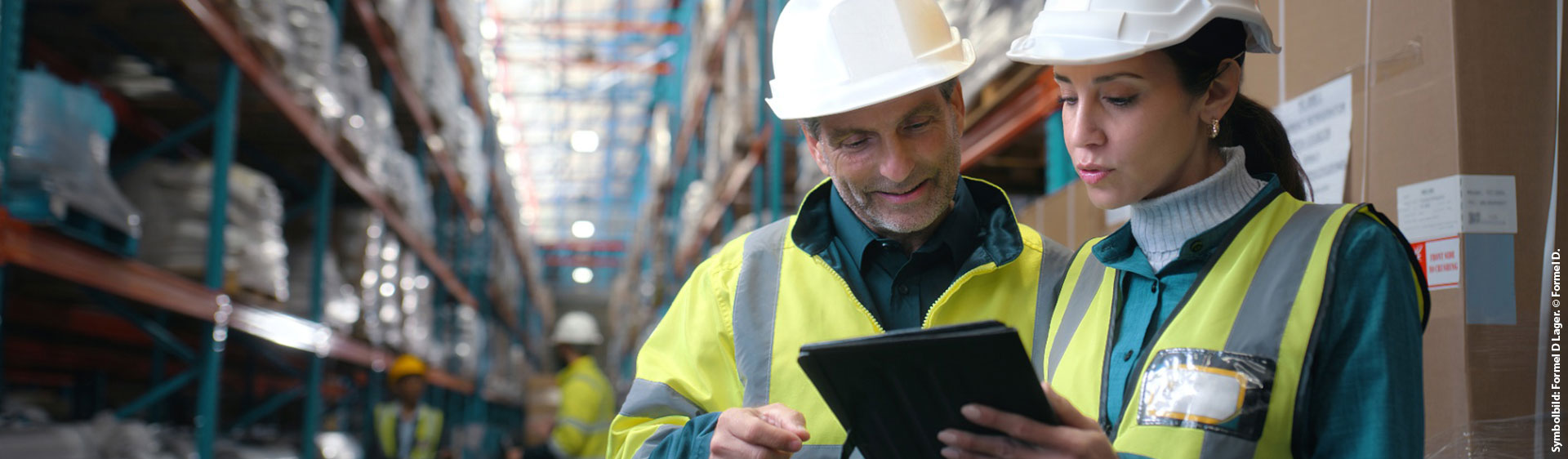
Through a bidirectional interface, STRADIVARI exchanges the required order data with the existing system. Employees record and process their tasks using mobile interfaces on tablets and scanners provided by ICS. The control center dashboard provides information on order status, material location, and throughput times to support the management of time-critical material flows.
The integrated solution is designed to provide end-to-end digital support for the entire process, from goods receipt, putaway, and order picking to internal transport, packaging, and preparation for shipment.
Solution
- Jointly developed solution, coordinated processes, and bidirectional system integration
- STRADIVARI.TLS, STRADIVARI.RTLS, mobile order processing, and control center dashboard
Project Status and Outlook
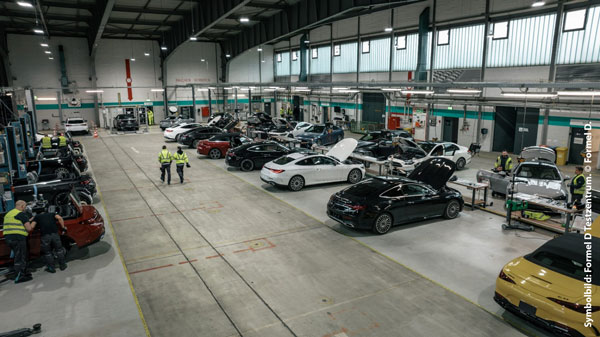
After approximately one and a half years of testing and validation at around one-third of the packing stations, the project is approaching its final go-live. Formel D and ICS are using insights gained from warehouse operations to further align technical functions with operational processes. In the future, the digitally managed processes are expected to help identify delays at an early stage, reduce potential sources of error in material consolidation, and enable more efficient use of resources (as of November 2026).
Formel D is a trademark of Formel D GmbH. All rights belong to the respective trademark owner. Images used: © Formel D.
Project Status
- Extensive testing under real-world conditions, with full go-live in preparation
- Expected benefits: early detection of delays, fewer potential sources of error, and optimized resource utilization

